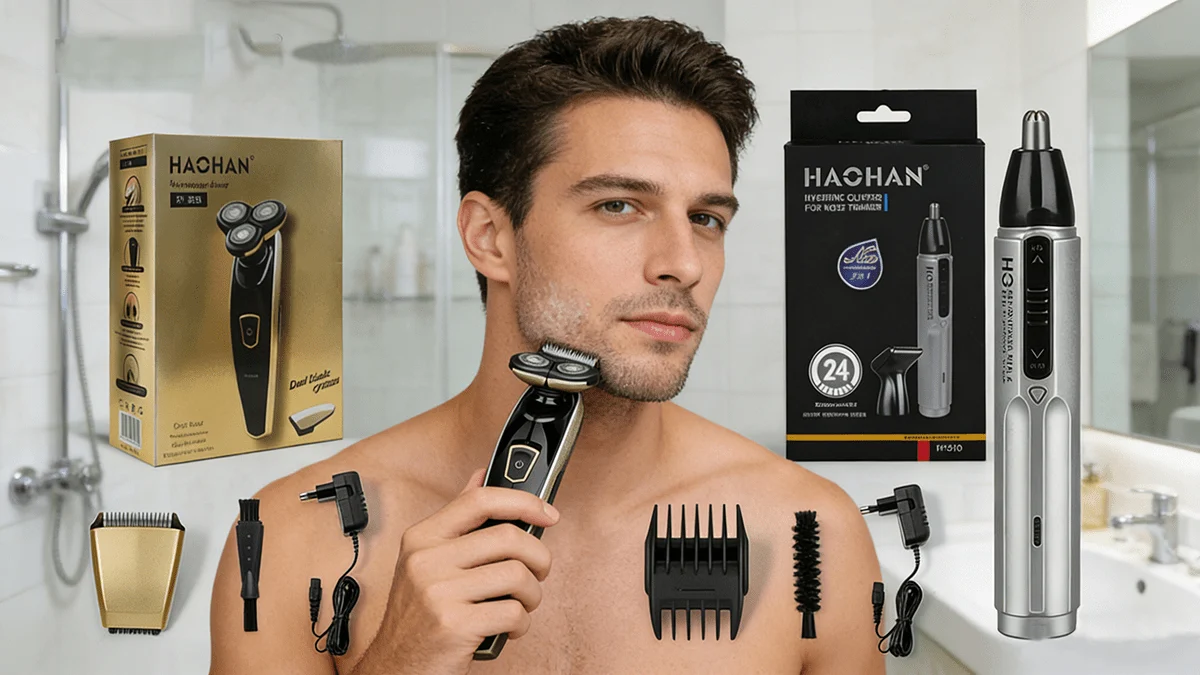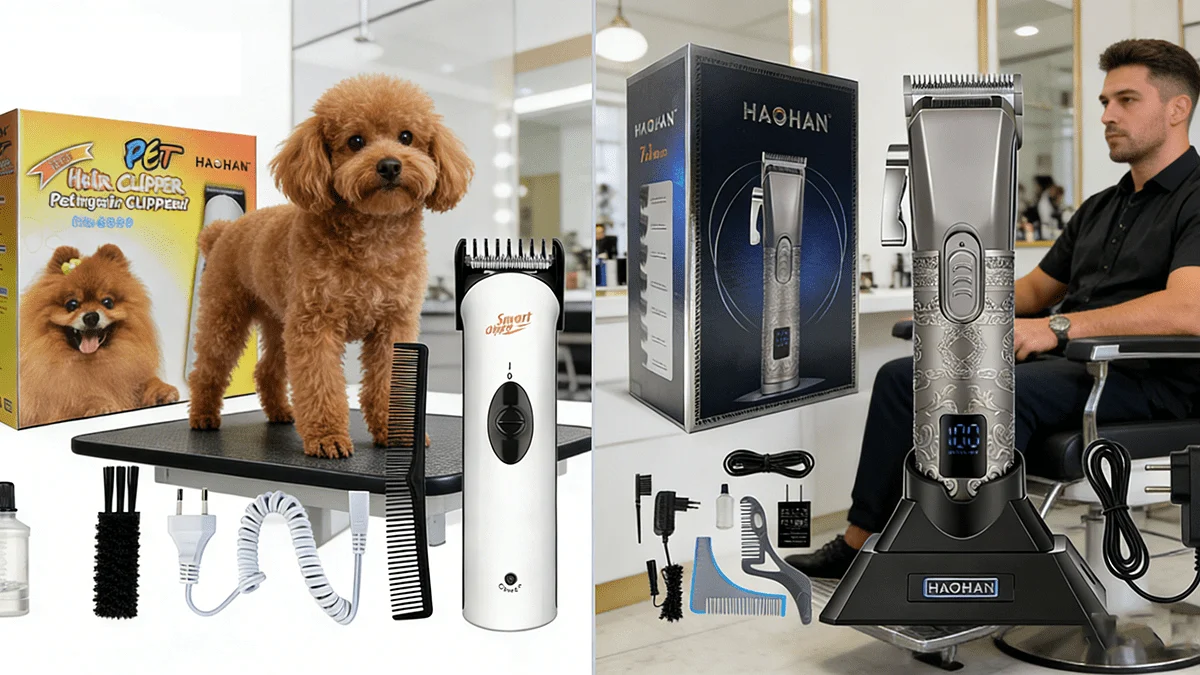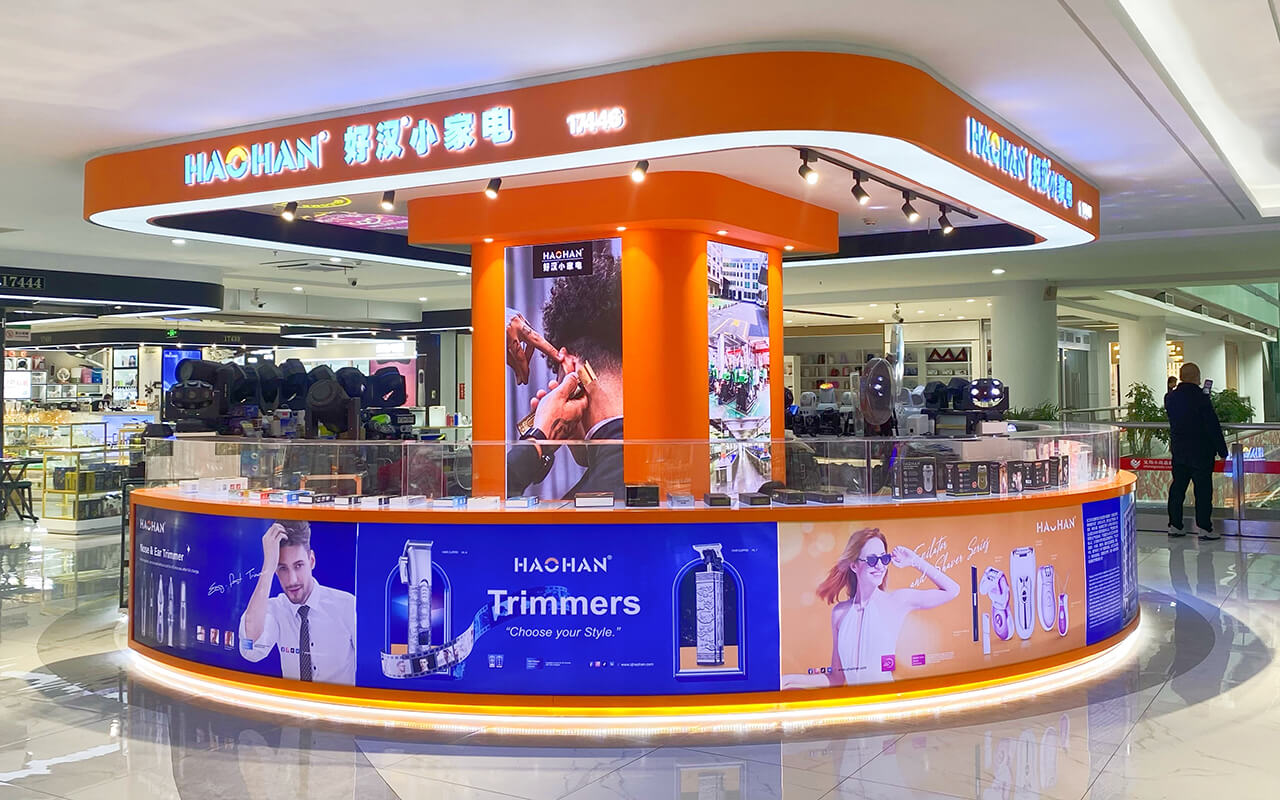
Looking for a reliable OEM/ODM partner to launch a professional grooming clipper brand in Europe — with full EU regulatory compliance, scalable production, and barber-grade performance? You’re not alone. Hundreds of brand owners and procurement managers face the same challenge: bridging technical gaps between market demand and certified manufacturing capability.
Case Study: Professional Grooming Clipper OEM Program for a European Barber Brand
Client Background
- Location: Germany, EU
- Role: Licensed practicing barber and emerging B2B grooming brand owner
- Pain Points:
- No in-house engineering or certification expertise — unable to define technical specs aligned with EN 60335-1 and EN 60745-1
- Uncertainty about CE marking scope (LVD + EMC + RoHS 3 + REACH SVHC screening)
- Concerns over motor noise (<72 dB(A) at 30 cm), blade precision (0.3 mm gap tolerance), and thermal stability after 45+ minutes continuous use
- Need for fast sample validation (≤7 days) before committing to volume orders
Key Requirements
- EU-compliant professional grooming clipper platform — fully certified for commercial sale across EEA member states
- OEM branding: laser-engraved logo on housing + custom blister packaging with multilingual (EN/DE/FR) safety labeling
- Minimum viable order: ≤5,000 units — no forced 10k+ MOQ
- Full documentation package: DoC, test reports (TÜV SÜD), RoHS/REACH declarations, WEEE registration support
- Supply chain transparency: real-time production tracking, pre-shipment QC inspection protocol (AQL 1.0)
Our Solution
Zhejiang Haohan Electric Appliance Co., Ltd. delivered a turnkey OEM hair cutting machine program — from concept validation to FBA-ready shipment — within 14 weeks.
- In-stock wholesale base model: 3.7 V Li-ion cordless clipper with 6,500 RPM high-torque motor, Japanese stainless steel blades (0.3 mm ±0.02 mm gap), and IPX4-rated housing
- Regulatory execution: Integrated CE certification (LVD 2014/35/EU, EMC 2014/30/EU, RoHS 2015/863/EU, REACH Annex XVII) — completed in 22 working days post-sample approval
- Customization execution: Laser-engraved logo (depth: 0.15 mm, width: 22 mm), dual-language packaging (EN/DE), and EU-compliant instruction manual (EN 60335-1:2012 + A11:2018)
- Logistics readiness: DDP delivery to German warehouse; EPR registration support for EAR and LUCID systems included
Technical Specifications
- Battery: 2,000 mAh Li-ion, 90 min runtime (full charge), 2.5 hr recharge time
- Motor: Brushless DC, noise level: 68.2 dB(A) @ 30 cm (measured per IEC 60745-1)
- Blade system: Self-sharpening stainless steel, adjustable 0.5–3.0 mm via rotary dial
- Compliance: CE, RoHS 3, REACH SVHC (233 substances tested, all <0.1% w/w), CB Scheme report (IEC 60335-1 & IEC 60745-1)
- Production capacity: 1.2 million units/year dedicated to barber-grade hair trimmer lines
Project Outcome
- First batch of 4,800 units shipped 11 days ahead of schedule — zero non-conformance in pre-shipment audit
- Brand launched on Amazon DE and local distributor channels with full CE documentation — zero regulatory holdbacks
- Unit cost reduced by 18% vs. prior quotation from three competing suppliers — attributable to integrated SMT + final assembly under one roof
- Repeat order placed at 12,000 units within 8 weeks of initial delivery
Why This Client Chose Haohan
- EU regulatory ownership: In-house compliance team handles full CE technical file preparation — no third-party dependency
- Barber-specific engineering validation: All clipper platforms undergo 200+ hours of real-world testing with licensed barbers across 5 EU countries
- No hidden MOQ escalations: Confirmed 3,000-unit MOQ for logo + packaging + color customization — documented in signed contract clause
- Sample-to-bulk timeline certainty: 7-day sample lead time guaranteed in writing; 14-week total project cycle from PO to EXW shipment
- Vertical integration: 30,000+ m² facility houses R&D, SMT line, injection molding, and dust-free assembly — eliminates subcontractor variability
- Post-launch support: Free revision of packaging artwork for EPR updates; lifetime access to updated DoC versions
Customization Options for Custom-branded grooming tool Projects
| Customization Parameter | Available Options & Minimum Order Quantities |
| Logo Application | Laser engraving (≥3,000 pcs), pad printing (≥5,000 pcs), embossing (≥10,000 pcs) |
| Voltage & Input Standard | EU: 230 V ~ 50 Hz input; global dual-voltage option (100–240 V) available at no extra cost |
| Battery Capacity | Standard 2,000 mAh; upgrade to 2,600 mAh (≥3,000 pcs) or 3,200 mAh (≥5,000 pcs) |
| Packaging Format | Blister pack (≥3,000 pcs), gift box (≥5,000 pcs), retail carton with EPR-compliant materials (≥10,000 pcs) |
| Color & Finish | RAL-matched ABS housing (≥3,000 pcs); matte/gloss finish options; metallic PVD coating (≥10,000 pcs) |
| Certification Support | CE (LVD/EMC/RoHS/REACH), CB, FDA 510(k) pre-submission review, WEEE registration guidance |
Launch Your EU-compliant clipper Brand With Confidence
Whether you’re a procurement manager evaluating Tier-1 OEM partners, a brand owner validating technical feasibility, or a distribution agent sourcing certified professional grooming clipper inventory — Haohan delivers verified engineering execution, documented compliance, and predictable timelines. No assumptions. No surprises. Just measurable outcomes.
Frequently Asked Questions
What is the minimum order quantity for customized professional grooming clipper units with logo and packaging?
We require a minimum of 3,000 pcs for laser-engraved logo + custom blister packaging + color-matched housing. This MOQ applies uniformly across all OEM hair cutting machine configurations — no tiered escalation based on voltage, battery capacity, or certification scope.
Can you supply barber-grade hair trimmer units pre-certified for EU market entry — including full CE technical documentation?
Yes. All EU-compliant clipper platforms ship with validated CE marking (LVD, EMC, RoHS 3, REACH SVHC), issued DoC, TÜV SÜD test reports, and multilingual labeling files. We prepare and retain the full technical file — not just a self-declaration.
Do you support mixed-SKU orders within a single container — for example, different blade types or battery capacities across one custom-branded grooming tool program?
Yes. We accept consolidated orders with up to four SKUs per carton (e.g., 2,000 mAh + 2,600 mAh variants; fine/coarse blade sets; black/silver housings). Each SKU retains its own serial traceability, AQL 1.0 inspection record, and compliance documentation.
How do you verify motor durability and blade precision before mass production of a professional grooming clipper?
We conduct three-stage validation: (1) 500-cycle endurance test on brushless motor under load; (2) gap measurement (0.3 mm ±0.02 mm) on 100% of blades using optical CMM; (3) real-world barber testing across five EU countries for thermal stability (>45 min continuous use) and noise (<72 dB(A)).
What lead time can I expect from final sample approval to EXW shipment for a custom-branded grooming tool order of 5,000 units?
Standard timeline is 14 weeks: 7 days for functional sample delivery, 22 working days for CE certification completion, 6 weeks for tooling and material procurement, and 2 weeks for assembly, QC, and logistics prep. We lock this schedule in writing upon contract signing.