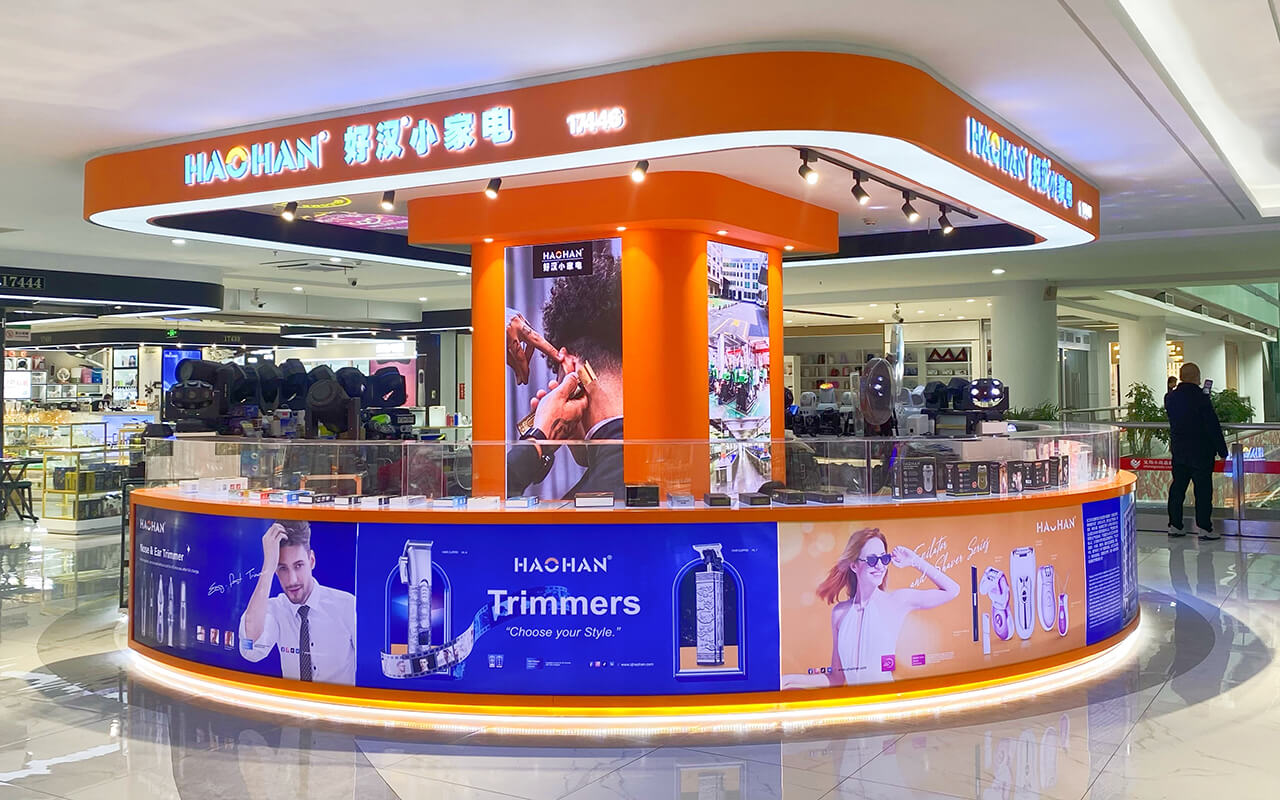
Need a reliable OEM partner for OEM hair trimmer kit development — fully compliant with Canadian regulations, shipped with bilingual packaging, and delivered on schedule? Zhejiang Haohan Electric Appliance Co., Ltd. delivers end-to-end private-label execution for global brands targeting the Canadian market.
Client Background
- Location: Canada
- Type: DTC brand owner operating via Amazon.ca and independent e-commerce channels
- Pain points:
- No in-house engineering or regulatory team — unable to interpret ISED (ICES-001), CSA C22.2 No. 67, or CPLA bilingual labeling requirements
- Lacked confidence in logo durability on stainless-steel clipper housings and battery compartment covers
- Required retail-ready packaging meeting Canadian shelf standards — including French/English safety warnings, importer address, and ENERGY STAR eligibility documentation
- Needed guaranteed lead time under 65 days from PO confirmation to FOB Yiwu shipment
Client Requirements
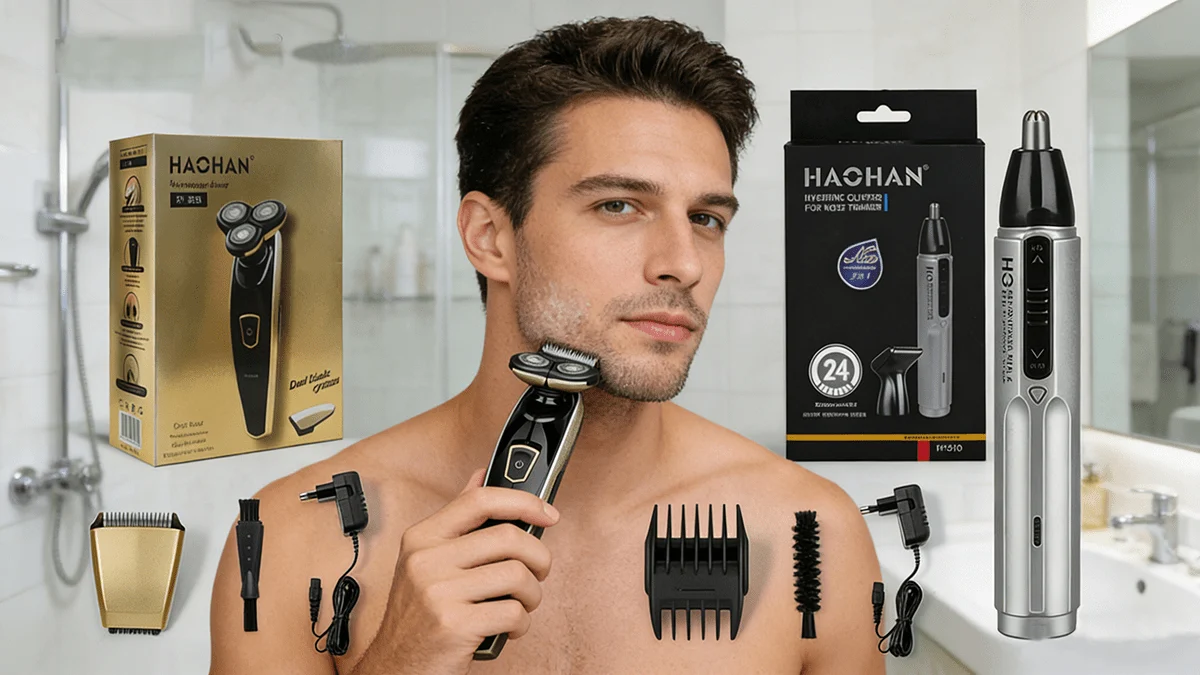
- Private-label custom-branded grooming set comprising cordless hair clipper, nose trimmer, ear trimmer, and cleaning brush
- Full-color printed retail box with dual-language (EN/FR) compliance labeling and UPC barcode
- CSA-certified motor, lithium-ion battery rated at 2000 mAh, 5-hour runtime, 90-minute charge time
- ISED certification support — including pre-scan testing, test report submission, and IC ID registration
- Minimum order: 3,000 units; first production run: 5,000 units
Solution Delivered
Haohan executed a turnkey professional cordless clipper bundle program across six phases:
- Regulatory alignment: Completed ISED (ICES-001) and CSA C22.2 No. 67 certification within 28 days using internal EMC lab + third-party accredited lab (UL Solutions, Toronto)
- Customization execution: Applied UV-resistant pad-printed logo on clipper body and charging dock; produced 100% custom-designed retail box with matte-finish lamination and die-cut foam insert
- Production control: Used SMT line for PCB assembly; assembled final units in ISO Class 8 cleanroom; conducted 100% functional burn-in and 3% AQL sampling per batch
- Logistics readiness: Provided CBSA-compliant commercial invoice, Form A Certificate of Origin, and HS code 8510.20.00 classification documentation
Technical Specifications
- Model: HH-CLP500-CA (Canada-specific variant)
- Motor: Precision-ground Japanese DC motor (rated 7,500 RPM, ±3% tolerance)
- Battery: 2000 mAh Li-ion, 7.4V nominal, cycle life ≥500 charges
- Run time: 5 hours (tested at 0.5 mm cutting depth, 20°C ambient)
- Charge time: 90 minutes (with 15W fast-charge adapter, input 100–240V AC)
- Certifications: ISED ICES-001, CSA C22.2 No. 67-19, RoHS 3 (2023), REACH SVHC-free
- Language compliance: Dual-language (English/French) user manual, safety labels, and packaging copy verified by native Canadian linguist
Project Results
- First container (FCL) shipped 62 days after PO confirmation — 3 days ahead of committed timeline
- Zero customs hold or labeling rejection at Canadian border — 100% CBSA clearance on first entry
- Product launched on Amazon.ca with “Ships from Canada” badge (via FBA Edmonton fulfillment center)
- Client achieved 22% repeat purchase rate within first 90 days — attributed to consistent unit performance and bilingual packaging clarity
Why Global Brands Choose Haohan for Canadian-market barber kit Development
- Regulatory ownership: In-house ISED/CSA project management — no subcontracting of certification workflows
- Tooling speed: Custom mold development completed in 18 working days (vs. industry average of 35+ days)
- Compliance-first packaging: Pre-approved bilingual label templates aligned with CPLA and Hazardous Products Act (HPA) requirements
- Scalable capacity: 10 million annual units production capacity — supports volume ramp from 3,000 to 50,000+ units without line reconfiguration
- Documentation integrity: All export documents (COO, CI, packing list) generated in real-time via ERP-integrated system — zero manual re-entry
- Post-shipment accountability: Dedicated QA engineer assigned per client — provides 30-day post-delivery defect root-cause analysis
Customization Options Available for private-label men’s grooming system
| Parameter | Available Customization |
| Logo Application | Pad printing (min. 3,000 pcs), laser etching (min. 5,000 pcs), or embossing (min. 10,000 pcs) |
| Packaging Format | Retail box (standard / premium matte), blister pack, or corrugated shipper — all bilingual EN/FR compliant |
| Electrical Compliance | Input voltage (100–240V), output voltage (5V/9V/12V), plug type (Type A/B/C), and ISED/CSA/cULus certification path |
| Battery & Charging | Li-ion capacity (1200–3000 mAh), fast-charge protocol (QC3.0/PD), and charger inclusion (wall adapter / USB-C cable) |
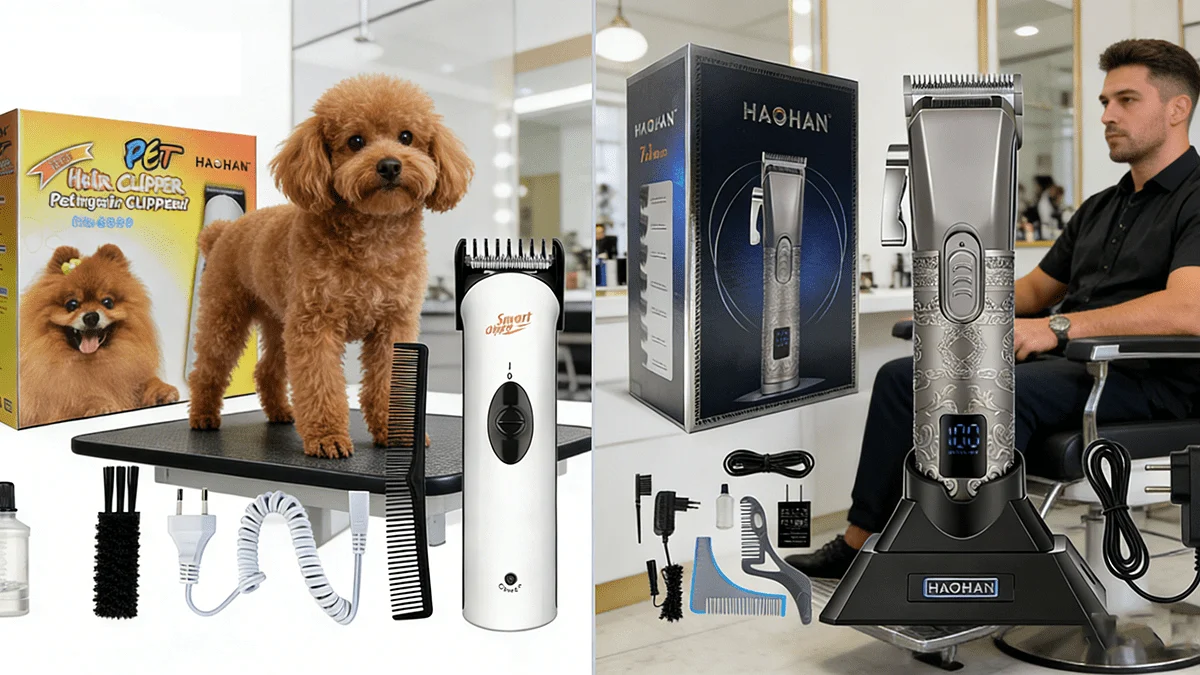
| Accessory Bundle | Comb attachments (3–9 mm), cleaning brush, oil bottle, charging dock — configurable per SKU |
Start Your custom-branded grooming set Project Today
Whether you require a single-model OEM hair trimmer kit or a multi-device Canadian-market barber kit, Haohan provides certified, scalable, and documentation-ready manufacturing — from technical feasibility review to FOB shipment.
Frequently Asked Questions
Can you supply OEM hair trimmer kit units without custom branding — for immediate resale under our own label?
Yes. We maintain active stock of core models (e.g., HH-CLP500 series) in standard configurations. Minimum wholesale order: 1 full carton. Units ship with neutral packaging, generic manuals, and no logo — ready for your private-label application or white-label distribution.
What lead time applies to a custom-branded grooming set with dual-language (EN/FR) packaging and ISED/CSA certification?
We deliver certified, retail-ready Canadian-market barber kit units in 62–65 days from PO confirmation. This includes regulatory testing, custom tooling, bilingual packaging production, and final QA. No third-party certification delays — all ISED ICES-001 and CSA C22.2 No. 67 work is managed in-house.
Do you support drop shipping or mixed-SKU orders for professional cordless clipper bundle fulfillment?
Yes. We accept consolidated orders across multiple SKUs — including different voltage variants, battery capacities, and accessory bundles — and ship pre-labeled cartons directly to FBA warehouses, 3PLs, or regional DCs. All documentation (packing lists, HS codes, COO) is ERP-generated and customs-ready.
How do you ensure consistent logo durability on stainless-steel surfaces for private-label men’s grooming system units?
We apply logos via industrial-grade pad printing using UV-cured ink (tested to ISO 2813 gloss & ASTM D3363 pencil hardness). For 3,000-unit orders, we provide printed sample validation reports and adhesion test results before mass production begins.
Can you modify technical specifications — such as motor RPM, battery capacity, or charging protocol — within a custom-branded grooming set project?
Yes. Our R&D team adjusts motor tuning, Li-ion cell selection (1200–3000 mAh), and fast-charge protocols (QC3.0/PD) per client requirements. All changes undergo functional validation, thermal stress testing, and EMC pre-scan before pilot run approval.