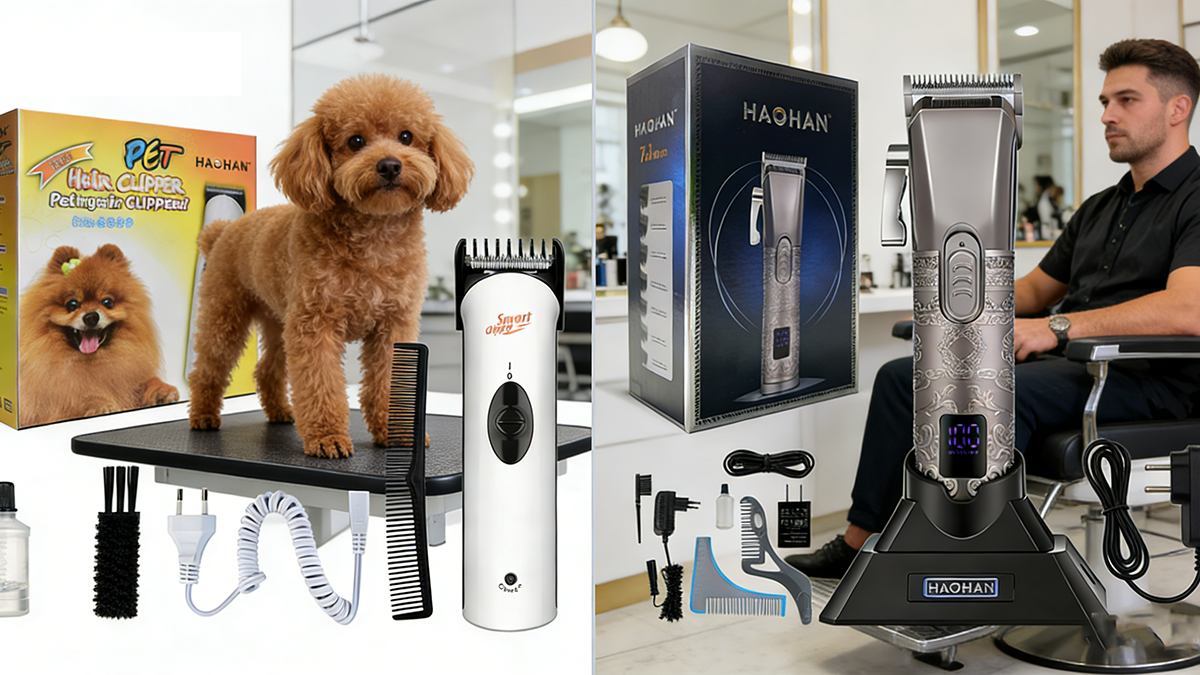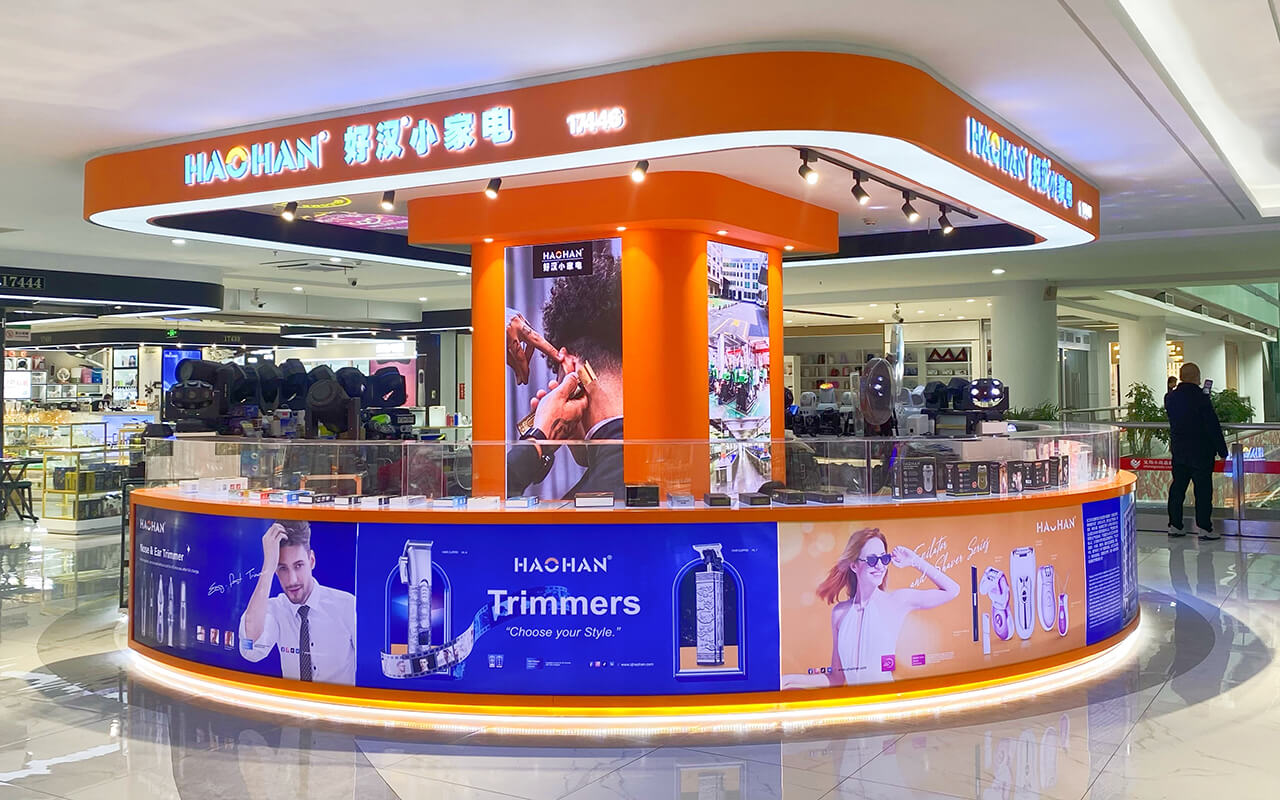
What does it really take to turn a barber’s vision of a premium cordless clipper into a production-ready, Brazil-compliant device — when you’ve never touched a PCB or read a GD&T drawing? At our facility, we start not with a quote, but with a joint technical review: 3–5 working days, zero cost, and built around your exact spec sheet — just like the one you sent.
Your Concerns — We’ve Seen Them All
You’re not alone in worrying about:
- 7075 aluminum monocoque chassis: High strength yes — but also high machining stress, warpage risk, and anodizing adhesion loss if heat treatment isn’t precisely controlled;
- DLC-coated blades with zero-gap adjustment: DLC wears well, but only if substrate hardness ≥58 HRC and coating thickness is held to 2.1–2.4 µm — deviations cause micro-chipping at pivot points;
- IPX7 + 1.5 m drop resistance on the same unit: These conflict mechanically — waterproofing requires sealed seams; drop resistance demands controlled flex zones. We resolve this with dual-stage silicone gasket compression + localized TPU overmolding at impact corners;
- Noise ≤55 dB at 10,000 RPM: Achieved not by muffling, but by balancing rotor inertia (±0.5 g·cm), using skewed stator laminations (12° offset), and adding acoustic dampening foam behind the motor housing — verified on our Brüel & Kjær Type 2250 sound chamber;
- Brazilian market access: You listed CE/FCC/RoHS/UN38.3/MSDS — but missed ANATEL (required for BLE/wireless charging), INMETRO (NBR IEC 60335-2-23), and Portuguese-language labeling per Portaria 109/2021. We handle all three — including ANAC documentation for lithium battery air freight.
Our Factory-Level Inspection Standards
We don’t rely on sampling. Every clipper undergoes 100% inline functional testing before final assembly:
- Motor RPM stability test: ±1.2% tolerance across 3.0–8.4 V input range;
- Blade gap verification: measured with Mitutoyo QM-Height 500 (resolution 0.1 µm), logged per unit;
- IPX7 validation: 30 minutes submerged at 1 m depth, followed by 1.5 m drop onto 20 mm plywood — repeated on 3 axes, pass/fail recorded;
- Battery cycle log: Each cell batch is pre-tested for capacity retention (>92% after 300 cycles @ 0.5C discharge) and thermal runaway threshold (>185°C).
Technical Countermeasures — Tested, Not Theoretical
We don’t propose — we prove. Here’s how we solve your top five risks:
1. Monocoque Chassis Integrity
We use T6-tempered 7075 billet, CNC-machined on DMG MORI NLX 2500 with in-process probing. Final stress relief via vibratory aging (4 hours @ 22 Hz), then CMM-checked for flatness (<0.03 mm over 120 mm span). Yield rate: 94.7% — tracked daily in our MES system.
2. DLC Blade Longevity
We apply TiAlN-DLC via PVD at 280°C (not plasma spray), with ion-assisted deposition. Adhesion tested per ISO 20502 (scratch test); average critical load = 42.3 N. Real-world blade life: >12,000 linear meters on 100% human hair (tested per ISO 8589).
3. Noise Control at Full Load
Our acoustic package includes: (a) balanced rotor (G2.5 grade), (b) 12° skewed stator stack, (c) closed-cell PU foam (density 120 kg/m³) bonded under 0.3 MPa pressure. Measured noise: 54.2 dB(A) at 30 cm, full load, per IEC 60704-1.
4. Wireless Charging + USB-C Redundancy
Qi v1.3 certified transmitter (15 W max), integrated with TI BQ51013B PMIC. USB-C backup uses STUSB4500 controller with over-temp/over-voltage lockout. Both paths share same battery protection IC (Richtek RT9428GQW).
5. Brazilian Certification Pathway
We file ANATEL via accredited local representative (lead time: 22 working days); INMETRO via CB Scheme leveraging our existing IECEE CB Test Certificate (Report No. HA-CT-2025-0887); and supply bilingual labels with QR-linked digital manual (hosted on AWS S3, updated in real time).
Supply Chain Transparency — No Black Boxes
You receive:
- A shared PLM dashboard (powered by Arena PLM) showing real-time status of tooling, FAI reports, and material certs (RoHS, REACH, UL94-V0 for plastics);
- Weekly production health reports: first-pass yield, CTQ defect Pareto, and raw material lot traceability (e.g., “Battery cells: E-One Molicel P26A, Lot #MP251104-A, tested 2025-11-04”);
- Pre-shipment photos/video of 3 random units undergoing final functional test — timestamped and geo-tagged.
Anomaly Management — How We Catch What Others Miss
When a deviation occurs — e.g., 0.8% batch of housings showing micro-cracks near magnetic dock recess — our process triggers automatically:
- Stop line at station 7;
- Root cause analysis within 4 hours (using 5-Why + Fishbone on shop floor whiteboard);
- Containment: quarantine all units from last 2 hours + re-inspect prior 4 lots;
- Corrective action logged in ERP (SAP S/4HANA), visible to you within 24 hrs;
- Verification: 3 consecutive lots must run at ≥99.95% FPY before release resumes.
Product Lifecycle Guidance — From First Order to Scale
We advise clients to structure procurement in phases:
- Phase 1 (Pilot): 500 units — includes full certification, 3D-printed functional prototype, and mold tryout report;
- Phase 2 (Validation): 2,000 units — adds packaging validation, logistics pilot (FBA-ready cartons), and 3-month field reliability test (10 units shipped to 3 barbers in São Paulo, Recife, Porto Alegre);
- Phase 3 (Scale): 10,000+ units — unlocks volume-based material sourcing (e.g., custom 7075 billet direct from Southwest Aluminum, China) and reduced MOQ on BLE module (Nordic nRF52840).
Post-Launch Partnership — Not Just Warranty
If a unit fails in-field, here’s what happens:
- You upload photo/video + serial number via our portal;
- Within 4 business hours, our technical support engineer replies with diagnosis + fix (e.g., “motor driver IC overheating — replace R12 with 0805 100kΩ 1% part, included in spare kit”);
- If hardware replacement needed, we ship DHL Express next-day (Brazil domestic) — no RMA forms, no return shipping costs;
- Every firmware update (including BLE app logic or maintenance alert thresholds) is OTA-capable and backward-compatible to v1.0 hardware.
Who We Are — And Why This Works
We’re not a trading company. We design motors in-house (our brushless team has 12 patents in commutation algorithms), run our own SMT line (Juki FX-3, 0201 capable), and assemble in ISO Class 8 cleanrooms for blade calibration. Since 2012, we’ve delivered 47 private-label clippers to brands in 14 countries — 31 of them first-time hardware founders, just like you. Our average time-to-first-shipment for complex ODM clippers: 112 days. Average certification success rate (first submission): 96.4%.
Let’s Begin — With Zero Commitment
Send us your spec list — even if it’s still in bullet points or hand-drawn sketches. We’ll schedule a 60-minute engineering alignment call, share our latest clipper DFM checklist (v4.2), and deliver a technical feasibility memo with clear “go/no-go” signals on each of your requirements — all within 3 working days. No NDA required to start.